Skip to product information
1 of 2

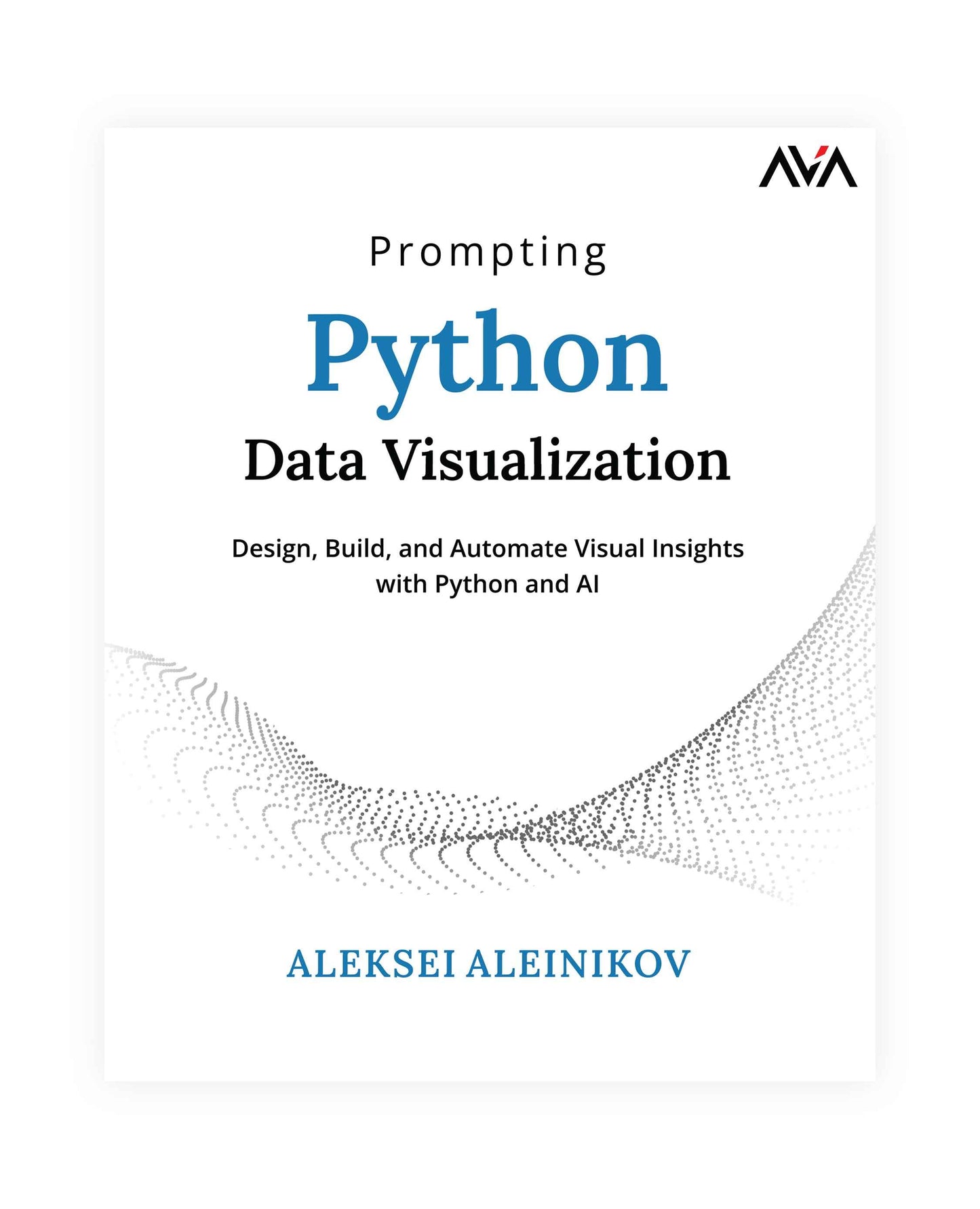
Prompting Python Data Visualization

Prompting Python Data Visualization

SKU:9789349887992

Regular price $44.95 USD
Regular price Sale price $44.95 USD
Sale Sold out
Taxes included. Shipping calculated at checkout.
Type

Free Book Preview

ISBN: 9789349887992
eISBN: 9789349887121
Rights: Worldwide
Author Name: Aleksei Aleinikov
Publishing Date: 17-Feb-2026
Dimension: 8.5*11 Inches
Binding: Paperback
Page Count: 402

Download code from GitHub

View full details

Collapsible content

Description

Turn natural language into production-ready Python charts

Key Features
● Get a free one-month digital subscription to www.avaskillshelf.com
● End-to-end Python visualization workflow, from data handling to production.
● Hands-on Matplotlib and Seaborn mastery, from fundamentals to advanced use.
● AI-powered visualization workflows using prompts, automation, and templates.

Book Description
Data visualization turns complex data into insight, alignment, and action—and it is a core skill for modern data, analytics, and engineering roles. Prompting Python Data Visualization shows you how to design clear, trustworthy visuals in Python, while accelerating the entire workflow by translating natural-language intent into working visualization code with AI.

You begin with the foundations of visual thinking and data handling, then build strong technical skills using Matplotlib and Seaborn. The book takes you from basic plots to advanced layouts, styling, annotations, time-series analysis, and publication-ready exports, grounded in real-world analytics and reporting use cases.

As you progress, you learn prompt engineering techniques to generate charts with AI, refine and debug AI-produced code, and automate repetitive visualization tasks using reusable prompt templates. By the end of the book, you will produce professional visuals for reports, notebooks, and dashboards with speed, consistency, and confidence.

What you will learn
● Apply visual thinking principles to design meaningful charts
● Build and customize Matplotlib visualizations for real-world use
● Use Seaborn to explore distributions, categories, and relationships
● Prepare Python visualizations for reports, dashboards, and publications
● Generate, refine, and automate plots using AI-driven prompts
● Apply ethical data storytelling and future-ready visualization practices

Who is This Book For?
This book is for Python Developers, Data Analysts, Data Scientists, Machine Learning Engineers, Business Intelligence Engineers, and Analytics Engineers who want to create professional, production-ready visualizations and accelerate their workflow using AI.

Readers should have a working knowledge of Python (functions, lists, dictionaries, NumPy/Pandas or DataFrames) and basic experience working with datasets.

Table of Contents

1. The Foundation of Visual Thinking
2. Setting Up Your Visualization Environment
3. Data Handling Essentials
4. Matplotlib Fundamentals
5. Customizing Matplotlib Aesthetics
6. Arranging Matplotlib Plots
7. Advanced Matplotlib Techniques
8. Preparing Matplotlib for Production
9. Introduction to Seaborn
10. Seaborn for Distribution and Categorical Data
11. Seaborn for Relationships and Matrix Plots
12. Advanced Seaborn Features
13. Prompting for Visualization Code
14. Refining AI-Generated Visualizations
15. Automation with AI Prompts
16. Building Reusable Prompt Templates
17. Data Storytelling and Ethics
18. The Future of Visualization AI
Index

About Author & Technical Reviewer

Aleksei Aleinikov is a Senior Platform and Cloud Engineer specializing in security-first cloud architecture and scalable systems. He builds reliable Python analytics and visualization workflows, focusing on IAM, observability, and operational rigor, and actively shares hands-on engineering insights with the developer community.

About the Technical Reviewer
Vignesh Durai
has over 15 years of experience and expertise in designing, modernizing, and leading the engineering of large-scale enterprises, spanning core platforms, integrations, and data-intensive applications deployed across on-premises and cloud environments. His interest in AI and Machine Learning (ML) has evolved from foundational data science work into a broader focus on embedding intelligence directly into enterprise systems and integration layers.

Vignesh has led high-performing engineering teams, overseen mission-critical modernization initiatives, and played key roles in large-scale transformation programs involving cloud adoption, API strategy, and intelligent automation. His career includes leadership and consulting roles at organizations such as Sentry Insurance, Cognizant, EY, and other global firms.

Currently, Vignesh works as a Software Engineering Manager and enterprise technology leader, focusing on building resilient systems, scalable integration architectures, and AI-enabled platforms that deliver measurable business outcomes. He is passionate about engineering leadership, applied AI in the real world systems, and mentoring teams to drive sustainable, data-driven transformation.

Tanisha Medewala
has more than 7 years of experience in building, designing, and engineering AI applications for enterprises. She has worked across a wide range of technologies, starting with client-based JavaScript tasks, and moving into Java development using microservices, Maven, and Spring Boot, before transitioning into the data and AI domain. She has worked with organizations such as Zoho, Orion Innovation, Zumen, CitiusTech, and IBM, where she led projects and built end-to-end applications for healthcare, procurement, and consulting services. Currently, Tanisha works as a Senior MLOps Engineer in the AI Client Services team at Fractal Analytics Pvt. Ltd., Bengaluru. In this role, she is responsible for designing and orchestrating scalable Azure ML pipelines enabling seamless model training, deployment, and monitoring across enterprise environments. She collaborates closely with data scientists, cloud engineers, and business stakeholders to translate analytical solutions into production-grade systems.

Her work focuses on enhancing the efficiency of the end-to-end machine learning lifecycle through robust data engineering practices, automation, CI/CD for ML systems, and the integration of generative AI and agentic AI with LLMOps capabilities.