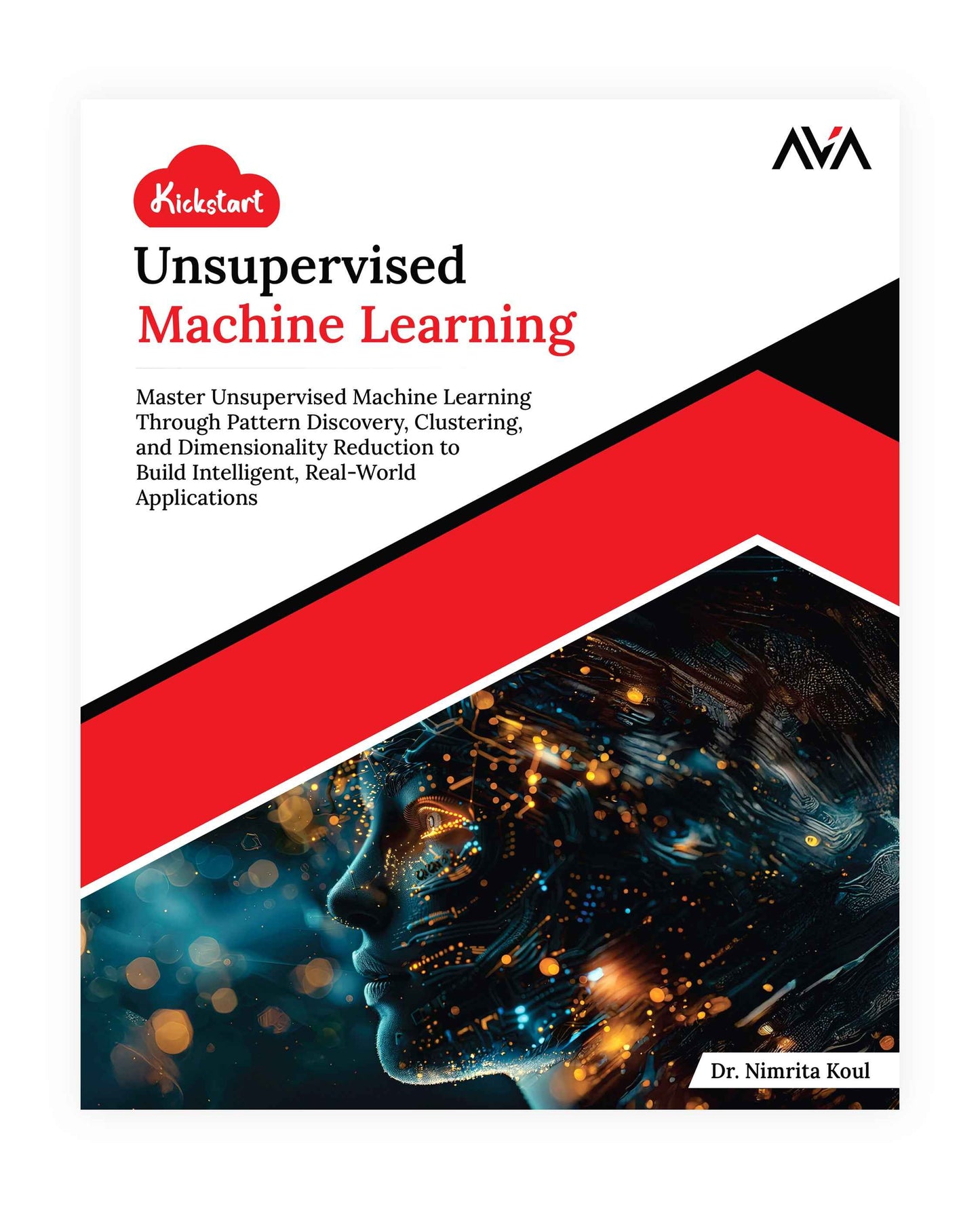
Unlock the power of unsupervised learning to uncover hidden insights and transform raw data into actionable knowledge.
Key Features
● Master unsupervised learning techniques for Machine Learning with real-world applications.
● Learn clustering, dimensionality reduction, and anomaly detection with real-world applications.
● Build practical expertise through step-by-step coding and practical examples as well as datasets.
Book Description
Unsupervised machine learning is revolutionizing how organizations extract value from raw data, revealing patterns and structures without predefined labels. From customer segmentation and fraud detection to generative modeling, its versatility drives innovation across industries.
Kickstart Unsupervised Machine Learning is your comprehensive companion to mastering this transformative field. Starting with the core principles, the book introduces essential clustering algorithms—including K-Means, DBSCAN, and hierarchical approaches—before advancing to dimensionality reduction techniques such as PCA, t-SNE, and UMAP for simplifying complex data. It then explores sophisticated models like Gaussian Mixture Models and Generative Adversarial Networks (GANs), combining theory with practical coding exercises and hands-on projects using real-world datasets to solidify your understanding.
Thus, by the end of this book, you will confidently evaluate, deploy, and optimize unsupervised models to derive meaningful insights from unstructured data.
What you will learn
● Understand the principles and algorithms of unsupervised learning from ground-up.
● Apply clustering and dimensionality reduction techniques on complex datasets.
● Evaluate and visualize models using key performance metrics such as validation and interpretability.
● Implement unsupervised workflows using Python and open datasets.
● Solve real-world challenges in NLP, image, and anomaly detection.
● Extend learning methods to research and production-level projects.
Who is this book for?
This book is tailored for data scientists, machine learning engineers, AI researchers, business analysts, software developers, and quantitative modelers who want to gain hands-on mastery in unsupervised techniques. It is equally valuable for undergraduate and postgraduate students, educators, and research scholars exploring clustering, dimensionality reduction, and anomaly detection. Professionals such as data engineers, research associates, statisticians and AI consultants will also benefit from the applied coding examples and deployment strategies.